Prabowo Warns of Rising Global Fears Over Potential World War III
President Prabowo Subianto has warned Indonesian government officials of growing global concerns over the possibility of a third world war, emphasizing that the consequences of a large-scale conflict—particularly one involving nuclear weapons—would extend far beyond the countries directly involved.
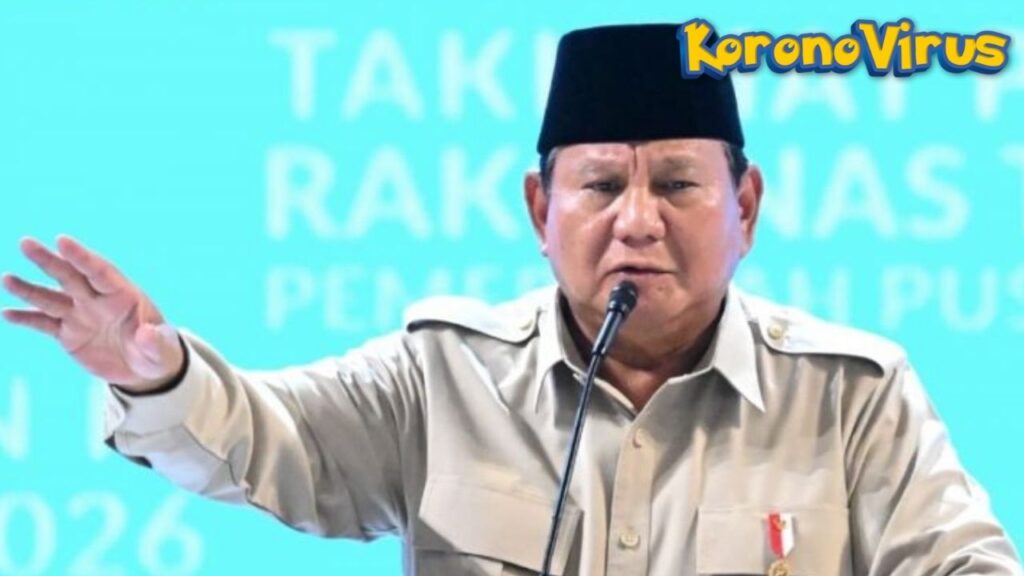
Speaking at the 2026 National Coordination Meeting of Central and Regional Governments held in Sentul, Bogor, West Java, on Monday, Prabowo highlighted escalating geopolitical tensions that have heightened global anxieties over the risk of a wider war.
“At the global level, there are concerns about World War III,” Prabowo said, as quoted by Antara.
Global Conflict Would Have Universal Consequences
Prabowo stressed that modern warfare—especially nuclear conflict—would not be confined to battlefields or national borders. Citing various international simulations and expert analyses, he warned that even neutral or uninvolved countries would face severe consequences.
“Even if we are not involved, we will still be affected by radioactive particles. Our fish could be contaminated,” he said.
According to Prabowo, nuclear conflict could also trigger a so-called nuclear winter, a scenario in which massive amounts of dust and debris block sunlight for prolonged periods. Such a phenomenon, he noted, would devastate agriculture, disrupt ecosystems, and threaten global food security.
“A nuclear winter could occur, blocking sunlight—not just for a year or two. Experts say it could last for decades,” he warned.
Environmental and Food Security Risks
The president underscored that Indonesia, as an archipelagic nation heavily dependent on marine resources, would be particularly vulnerable to radioactive contamination of oceans and fisheries.
He warned that fallout from nuclear explosions could pollute seas and coastal ecosystems, endangering fish stocks and the livelihoods of millions of Indonesians. Beyond environmental damage, Prabowo said prolonged climate disruption would threaten global food supply chains, potentially leading to famine and economic instability.
These risks, he said, demonstrate that no country can consider itself safe from the consequences of a global war in today’s interconnected world.
Commitment to an Independent and Active Foreign Policy
In response to these global threats, Prabowo reaffirmed Indonesia’s long-standing commitment to an independent and active foreign policy, rooted in non-alignment and the rejection of military blocs.
He described the policy as both a constitutional mandate and a historical legacy inherited from Indonesia’s founding fathers, who sought to keep the country free from great-power rivalries.
“Our foreign policy is independent and active. We are not aligned with any military bloc,” Prabowo said.
However, he cautioned that non-alignment does not equate to passivity or dependence on others for protection.
Non-Alignment Requires Self-Reliance
Prabowo emphasized that choosing not to join military alliances carries significant responsibility. Without formal defense pacts, Indonesia cannot assume that other nations would automatically come to its aid in the event of an attack.
“If we truly want to be non-aligned and not tied to military pacts, that means we stand on our own. If we are threatened or attacked, no one will automatically come to our aid,” he said.
As a result, Prabowo argued that Indonesia must strengthen its national resilience, defense capabilities, and confidence in its own ability to protect its sovereignty.
Power Still Shapes Global Relations
While acknowledging the importance of diplomacy and international cooperation, Prabowo offered a sober assessment of global politics. He noted that international relations remain heavily influenced by power dynamics rather than ideals alone.
“International relations are not based purely on goodwill or ideals. Power still matters,” he said.
This reality, according to Prabowo, requires Indonesia to remain vigilant, pragmatic, and prepared—especially in an era marked by strategic competition among major powers.
Protecting National Security a Core Responsibility
Prabowo stressed that his foremost duty as president is to safeguard Indonesia’s national security and ensure the safety of its people.
“My responsibility is to protect the Indonesian people,” he said, adding that preparedness is not a sign of aggression but a necessary preventive measure.
He reiterated that Indonesia does not seek war and remains committed to peaceful relations with all nations. However, he emphasized that readiness and deterrence are essential to prevent external threats from materializing.
Natural Resources and Historical Lessons
The president also pointed to Indonesia’s abundant natural resources, noting that such wealth has historically attracted foreign interest—and, at times, exploitation.
Referring to Indonesia’s colonial past, Prabowo said history offers a powerful lesson about the importance of vigilance and self-determination.
“Our history teaches us that weakness invites intervention,” he said.
He stressed that safeguarding sovereignty requires not only military preparedness, but also economic strength, national unity, and confidence in Indonesia’s own capabilities.
Balancing Openness and Sovereignty
In closing, Prabowo emphasized that Indonesia must continue to present itself as a friendly and cooperative nation, while firmly defending its independence.
“Indonesia must remain a friendly nation, but also a sovereign one,” he said.
He underscored the need to strike a balance between openness to global engagement and resilience against external pressures, particularly in an increasingly uncertain international environment.
Conclusion
Prabowo’s warning reflects rising global anxiety over escalating geopolitical tensions and the potential consequences of large-scale conflict. By highlighting the universal impact of nuclear war and reaffirming Indonesia’s commitment to non-alignment and self-reliance, the president underscored the importance of preparedness, vigilance, and national resilience.
As global uncertainty grows, Indonesia, he said, must remain steadfast in protecting its sovereignty—while continuing to advocate for peace in an increasingly fragile world order.
Baca Juga : Puluhan Pak Ogah Dirazia di Cengkareng, Dibina Dinsos
Cek Juga Artikel Dari Platform : beritabandar